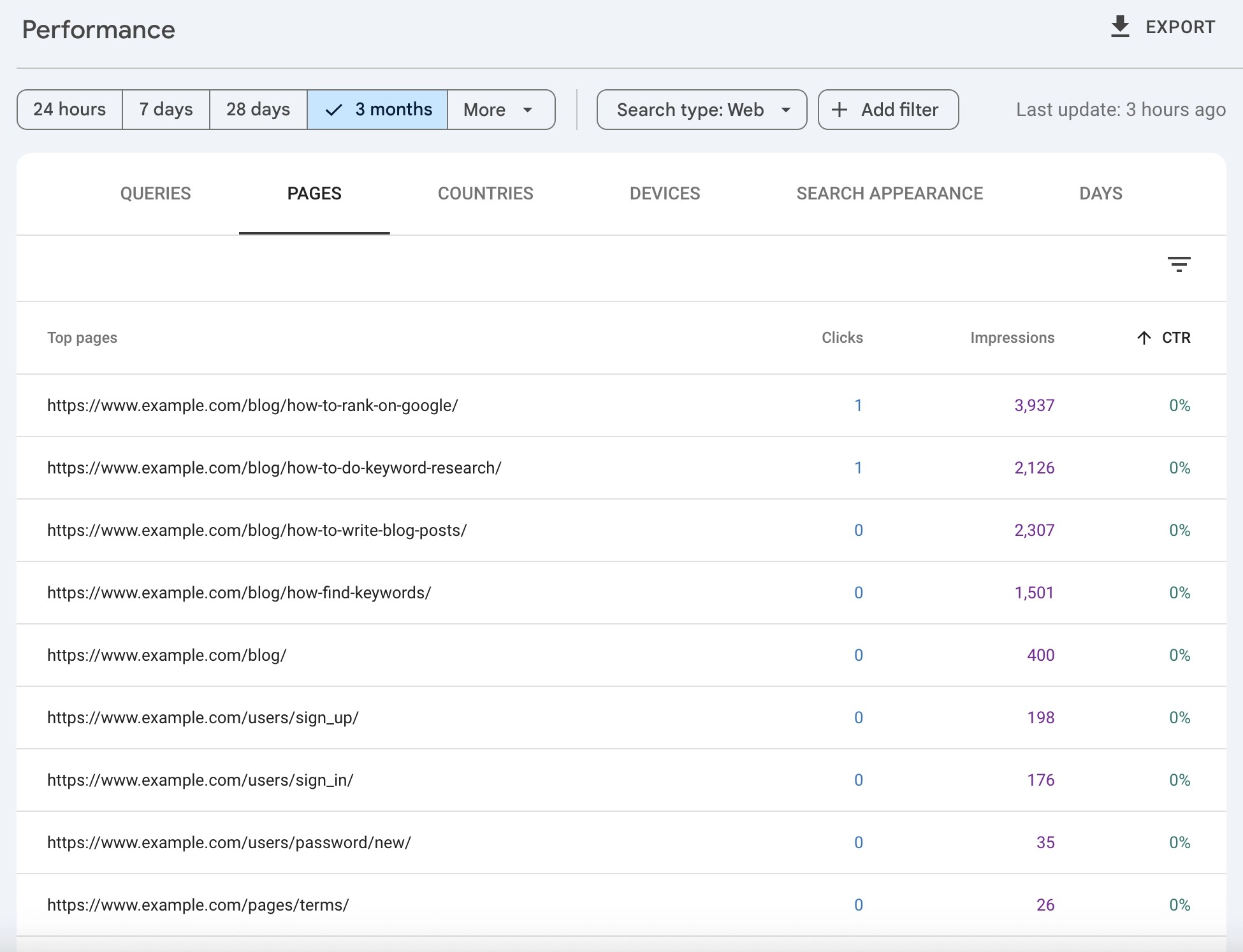
You open Google Search Console, and you are finally seeing growth.
Your impressions are scurrying. Some pages are hitting 10,000, 20,000, even 50,000 impressions. It is as though you are getting results with your SEO.
Next,t you check clicks.
And all things are slowed down.
A page that is on the first page hardly receives traffic. Another good potential keyword targeting is not at all being considered. You begin to doubt your material, your links, your plan.
However, the truth that most people overlook here is:
“There is nothing wrong with your rankings. What’s broken is your click-through rate (CTR).”
I have found myself in this very circumstance. I had pages at positions 4 and 5 with thousands of impressions per week in my account, but CTR was only in the single digits. Initially, I believed I needed additional backlinks or content.
I didn’t.
What I had to do was to get people to click.
Impressions Without Clicks Are Wasted Rankings
To be ranked on Google is just half the battle.
When you do not get clicks, then you are losing traffic every single day. And not only traffic, but you are losing possible leads, conversions, and power.
Any impression is an opportunity to win a click.
Each impression that is not taken is an opportunity lost.
This accumulates in the long run. A page has 30 000 impressions and 2% CTR, which gives 600 clicks. The page with 6% CTR receives 1,800 clicks.
It is 1,200 additional visitors without the increase in rankings.
This is the reason why CTR optimization is among the quickest methods of developing organic traffic.
Locating Your CTR Issues in Google Search Console.
You must first find out where the problem exists before you fix it.
Log in to the Google Search Console and click on Performance report. Select a date range of the past 3 months to ensure that you have sufficient data.
Now switch to the “Pages” tab and sort by impressions.
You are seeking pages that satisfy three criteria:
- Large impressions (at least several thousand)
- Between positions 3-10.
- Low CTR compared to their position
These pages are already visible. They just aren’t converting impressions into clicks.
When I began to do this, I discovered a page that had about 18,000 impressions and a 1.9% CTR at position 5. Once the title and meta description optimization were optimized, CTR went above 5 percent in a few weeks.
That one-page change increased the amount of traffic threefold.
What a “Good” CTR Actually Looks Like
CTR depends heavily on your position in search results.
Here’s a general benchmark:
| Position | Expected CTR |
| 1 | 25–35% |
| 2 | 12–18% |
| 3 | 8–12% |
| 4–5 | 5–8% |
| 6–10 | 2–5% |
If your CTR is significantly below these ranges, there’s a problem with how your result appears in search.
And that problem is fixable.
Why Visitors Bypass Your Entry.
After you have identified pages that are not performing well, you should then diagnose them.
Enter your search keyword in Google and review your search and competitors.
There are some definite problems that you will tend to see.
Your Title appears to be generic.
The common feature of most pages with low-CTR is that the title blends in.
Titles like:
- “SEO Tips for Beginners”
- “Blogging Guide”
- “Best SEO Tools”
don’t stand out.
They do not make any particular promises. They don’t create curiosity. They don’t give users a reason to click.
And now compare that with something more interesting:
- 11 SEO Tips That Will Work in 2026.
- Why Your Blog Isn’t Ranking (And How to Fix It Fast)
The distinction is precision and clarity.
I found that generic titles do not do well when I was working on comparison content, such as Ahrefs vs SEMrush. However, CTR was much higher when I reworded the title to concentrate on decision-making, assisting users in selecting the more suitable tool.
Also Read: 12 Reasons Your Website Is Not Ranking on Google (And How to Fix Them)
Your Meta Description is No Sell
The majority of people consider meta descriptions as summaries.
That’s a mistake.
The definition that you are giving about yourself is your chance to convince the user.
A poor description merely describes what the page is all about. A powerful description communicates the problem of the user and provides a distinct advantage.
For example:
Weak:
“This article describes the methods and techniques of SEO.”
Strong:
Having a hard time getting traffic? Learn the specific SEO techniques that have been used to grow my clicks 3 times in weeks.
The second version provokes curiosity and gives assurance of the outcome.
That’s what drives clicks.
Your Page Doesn’t Correspond to Search Intent.
In some cases, it is not about your title or description. It’s alignment.
When your page is not what the user is seeking, they will not even bother to click it, even when you rank highly.
As an illustration, when an individual types in best SEO tools, he or she wants a list or a comparison. Your page will not be a general guide, so it will not seem relevant.
This is what I knew when writing such content as Best Ahrefs Alternatives to SEO. Users who seek alternatives desire options, comparisons, and fast insights. They will skip your result in case you give them a lengthy theoretical guide.
It is important to match the intent to search to enhance CTR.
The Secret to Writing Title Headings That Will Be Clicked.
The most crucial aspect in CTR is your title tag.
The slightest wording can double your clicks.
Good performing titles typically contain:
- The primary keywords at the start.
- An obvious advantage or result.
- Specificity (numbers, years, results)
- A bit of interest.
For example:
Instead of:
“SEO Guide”
Use:
Complete SEO Guide for Beginners (2026 Step-by-Step)
The second title informs the user of what they are going to get.
Title: Structures That Consistently Work
These formats will get you out when you are stuck:
- Numerical: 7 effective tips to increase CTR.
- Problem-solution: Why Your Website Isn’t Ranking (Fix It Fast).
- Comparison: Ahrefs vs SEMrush: Which Tool is Better in 2026?
- Result-oriented: How to Increase Organic Traffic Without Backlinks.
I tend to go through several options with frameworks such as ChatGPT Prompts SEO that can be used to create various angles and determine the most clickable one.
How to write Meta Descriptions that get Clicks.
Although Google occasionally paraphrases meta descriptions, it is important to write a good meta description anyway.
Consider it ad copy.
A good meta description ought to:
- Find a solution to the problem of the user.
- Guarantee an evident result.
- Create curiosity
- Include a slight call to action.
For example:
Your impressions are good, and clicks are low. Find out the easiest way to optimize your CTR with the best strategies that work.
It is a kind of description, not merely descriptive but convincing.
Making use of Structured Data to shine.
No longer are search results a set of blue links.
Some results show:
- Ratings
- FAQs
- Additional links
They are referred to as rich snippets, and they boost visibility.
When your competitors possess the m, and yours do not, their performance is going to be more likely to get clicks.
Introducing structured data, ta such as:
- Article schema
- Review schema
- FAQ schema
can assist in making your outcome more graphic.
The Impact of SERP Competition
It is not only rankings that you are competing with, but also attention.
You may be ranked higher, but a more convincing outcome beneath will steal clicks.
I have observed that a page at position 6 performed better than a page at position 3 because the titles of the pages were better.
This is more so in competitive subjects, such as my blogging strategy or tool comparisons.
Users say. They don’t analyze deeply.
The outcome that emerges is victory.
Measuring Your CTR Improvements
Once you make changes, you cannot expect immediate results.
Google will require time to re-crawl your page and re-index.
Typically:
- Title updates appear in 1-2 weeks.
- The changes in CTR are evident in 3-4 weeks.
When measuring performance:
- Before vs after.
- Look at the same time period.
- Focus on both CTR and total clicks.s
Ranking changes sometimes give us C, TR, but Impressidecreases and therefore should be both evaluated.
Common Mistakes That Kill Over time, I have identified a couple of mistakes that occur regularly:
- Composing search engine titles, rather than user titles.
- Ignoring search intent
- Generalized language.
- Not testing different variations.
- Mimicking competitors and not making improvements.
These are only a few of the things that you should avoid to get a better CTR.
Final Thoughts: Ranking Is Only Step One
The majority of individuals concentrate all their energy on ranking.
But ranking is just the beginning.
Unless your result is clicked by the user, it does not become traffic.
When I began to consider titles and meta descriptions as elements of conversion, not solely of SEO, everything became different.
Traffic increased. Engagement improved. Nor was I forced to make new content to make it happen.

Harsh Raj Yadav is a digital marketing professional based in India, specializing in SEO. He is also an active blogger who regularly publishes insightful articles on his personal website, digitalharshraj.com. His content focuses on digital marketing strategies, SEO techniques, and industry trends, providing practical value to readers.